
You keep ending up in the same relationship. Different face, different name, same exhausting pattern. The partner who controls everything. The one who disappears emotionally. The one who makes you feel like you’re going crazy for wanting basic respect. You leave, you heal, you swear it won’t happen again. Then six months later, you’re sitting across from someone new who feels suspiciously familiar.
If that cycle sounds personal, your karmic tail might explain why.
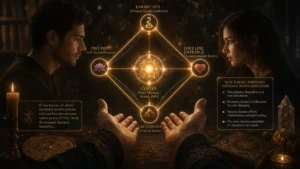
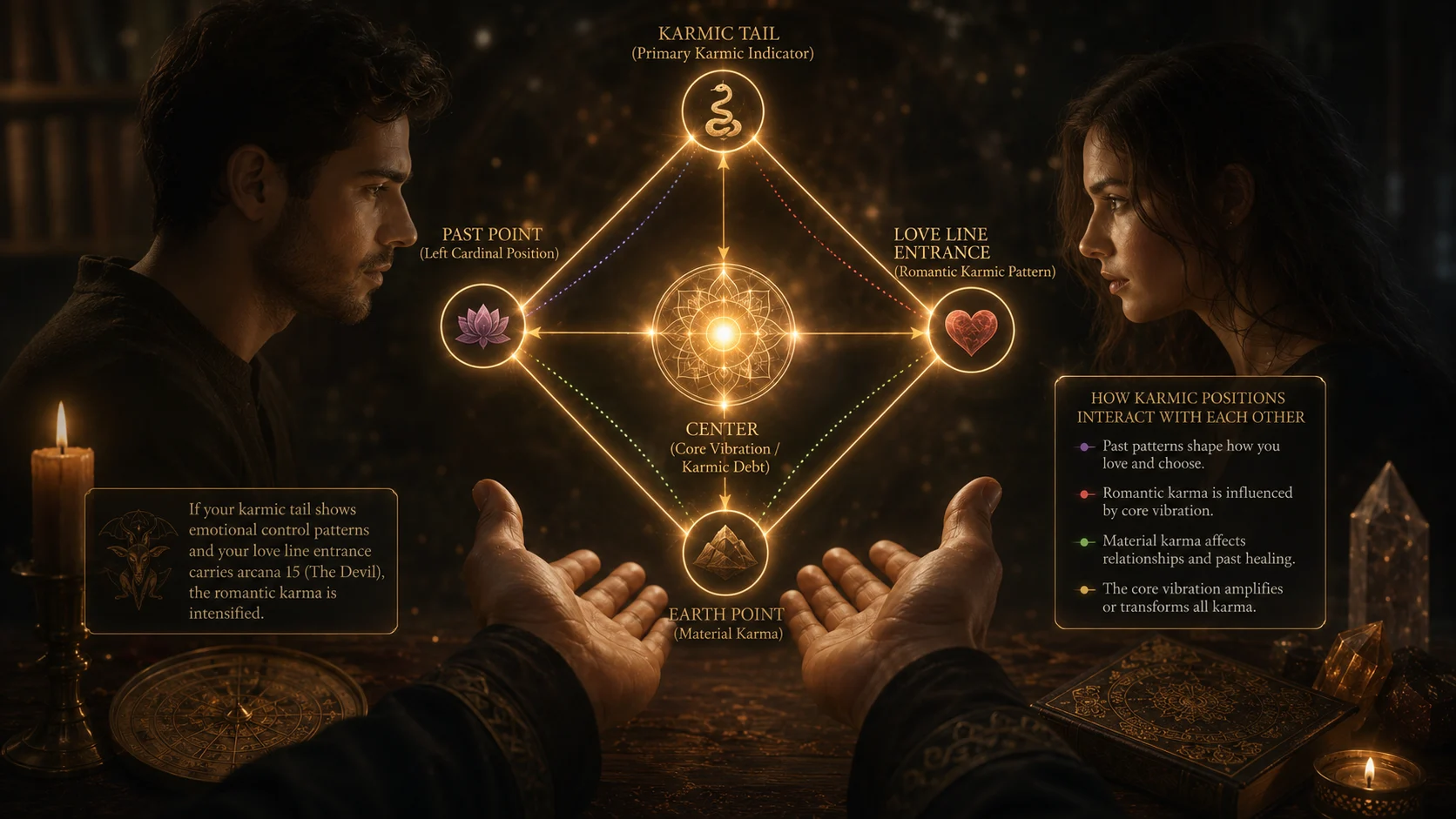
In the Destiny Matrix system, the karmic tail is a set of three numbers at the very bottom of your chart. These numbers represent unresolved energy from past incarnations: behavioral patterns, emotional debts, and relational dynamics that your soul carried into this lifetime. When those energies sit in their negative expression, they don’t just create random bad luck. They create specific, repeatable patterns, especially in relationships.
Not all karmic tails produce toxic relationship cycles. But certain combinations are relationship danger zones. They generate patterns of control, codependency, manipulation, aggression, or emotional unavailability that repeat until the underlying karma is consciously addressed.
Let’s break down which tail combinations create which patterns, and what it actually takes to break the loop.
How the Karmic Tail Connects to Relationship Patterns

Before getting into specific combinations, you need to understand why the karmic tail impacts relationships so directly.
The karmic tail sits at the base of the Destiny Matrix chart, energetically connected to the Muladhara (root) chakra. This chakra governs survival, safety, and your most fundamental sense of security. When the root energy is destabilized by unresolved karma, it distorts how you relate to other people at the most basic level. Trust, boundaries, emotional regulation, attachment style: all of these are filtered through the root.
The three numbers in your karmic tail each tell a different part of the story. The first number (Position 1) describes the dominant past-life pattern. This is where the karma originated. The second number (Position 2) shows how that pattern manifests in your current life. The third number (Position 3) indicates what the pattern attracts, specifically the type of person or dynamic you pull toward you when the energy is negative.
In the Destiny Matrix framework, you cannot fully activate your love line or money line until you consciously heal the karmic tail. Ignoring the karmic sequence leads to what practitioners call the “karmic loop,” repeating the same painful scenarios in relationships, careers, and finances until the lesson clicks.
There are exactly 26 karmic tail combinations in the system. Each has a name that captures the essence of the past-life pattern: Love Magic, Warrior, Emperor, Pride, Rebel, Dark Mage, and others. Not all of them are relationship-focused. But the ones that are tend to produce the most visible and painful cycles.
The Captivity Tails: Addiction, Control, and Feeling Trapped

Several karmic tail combinations revolve around themes of captivity, restriction, and addictive behavior. These tails frequently contain the number 15 (The Devil), which in its negative state governs addiction, manipulation, material obsession, and the inability to walk away from situations that are clearly destructive.
The past-life pattern for these tails typically involves either being controlled by someone else or controlling others through force, substances, or psychological dominance. In some cases, the person was the one trapped. In others, they were the one holding the cage shut.
In the current life, this manifests in several recognizable ways. The person may feel trapped in toxic relationships or habits. They struggle to assert themselves or say “no.” They constantly seek validation from others. Addictive patterns (substances, sex, gambling, or even toxic relationship addiction itself) may surface repeatedly. They attract partners who are controlling, or they become the controlling one.
The toxic relationship cycle here is one of the most stubborn in the entire system. The person enters a relationship that feels intense and magnetic (Devil energy is always magnetic). The intensity gets mistaken for love. Then the control begins, from one side or both. The person wants to leave but can’t. They feel bonded to the dynamic even when they recognize it’s destructive. They finally break free, then find themselves in an almost identical situation within months.
Breaking this tail requires reclaiming personal independence and developing the ability to recognize the difference between intensity and intimacy. Intensity is not love. Magnetism is not compatibility. The karmic lesson is learning to walk away from what feels powerful but isn’t actually good for you.
The Aggression Tails: Violence, Anger, and Explosive Dynamics

Karmic tail combinations involving themes of physical aggression represent some of the most serious relationship danger zones in the Destiny Matrix. These tails often contain energies associated with arcana 11 (Strength in its negative expression: aggression, domination, physical force) and arcana 16 (The Tower: sudden destruction, explosive upheaval, emotional volatility).
The past-life pattern involves the use of force, violence, pressure, or suppression of others. The person may have been an aggressor in a previous life, using physical or psychological power to dominate. Alternatively, they may have been the victim of such aggression.
In the current life, the pattern produces one of two dynamics. Either the person carries unresolved anger that surfaces in relationships as controlling behavior, verbal aggression, or physical intimidation. Or the person is drawn to partners who display those exact traits, recreating the victimization pattern from the past life.
A practitioner example commonly cited in Destiny Matrix literature describes a woman living with an alcoholic partner, suffering for years while blaming everyone around her. The karmic tail reveals that she herself dealt with addiction in a past incarnation and caused suffering to others through it. The pattern isn’t punishment. It’s a mirror. The cycle repeats until the person recognizes their own past energy reflected in their current circumstances and chooses to respond differently.
The resolution for aggression tails involves developing emotional regulation, learning conflict resolution without force, and recognizing when anger is being used as a substitute for vulnerability. The person needs to acknowledge both the aggressor and the victim within themselves. Healing requires engaging with both sides honestly.
The Pride Tails: Superiority, Narcissistic Dynamics, and Emotional Distance

Pride-based karmic tails are sneaky. They don’t look like obvious danger zones on the surface. The person often appears modest, even shy. But underneath that exterior sits an astonishing level of pride that distorts every relationship they enter.
The past-life pattern involves receiving unearned gifts, privileges, help, and opportunities that weren’t earned through genuine effort. The soul became accustomed to being treated as special, and developed a sense of superiority that went unexamined because the external circumstances kept reinforcing it.
In the current life, this tail creates relationships built on unspoken hierarchies. The person may unconsciously view their partner as beneath them, even while appearing outwardly caring. They may associate only with people they consider successful or influential. They struggle to accept imperfection in themselves or others. They procrastinate driven by a fear of not being good enough, then project that fear onto their partner as criticism.
The toxic cycle here often looks like emotional unavailability wrapped in a respectable package. The person seems like a good partner on paper. But they never fully open up, never fully commit at the emotional level, and never allow their partner to see the parts of them that aren’t polished. The partner feels perpetually kept at arm’s length without being able to articulate why.
Breaking the pride tail requires practicing vulnerability deliberately. It means allowing imperfection to be visible. It means recognizing that the impulse to judge others is usually a deflection from self-judgment. And it means building relationships where both people are genuinely equal, not just performing equality while maintaining an internal sense of superiority.
The Warrior of Faith Tails: Ideology Over Intimacy

The Warrior of Faith tail (commonly identified as 21-10-7) produces a specific type of toxic relationship pattern that revolves around control through belief systems.
The past-life pattern involves using charisma, talent, or spiritual authority to influence and control others. The person may have been a religious leader, political figure, or community authority who imposed their views rather than sharing them. They refused to accept differing beliefs. They violated boundaries in the name of righteous purpose.
In the current life, this tail creates relationships where one partner’s worldview dominates at the expense of the other’s autonomy. The person may be dogmatic about how things “should” be. They may frame their controlling behavior as guidance, mentorship, or spiritual leadership. They struggle to accept that their partner has the right to different beliefs, different priorities, and different ways of living.
The toxic cycle often involves the person attracting partners who are either submissive (reinforcing the control pattern) or equally dogmatic (creating constant ideological warfare). Neither dynamic produces genuine intimacy because the relationship is built on power rather than partnership.
The resolution involves cultivating tolerance, surrendering the need to be right, and learning that faith expressed through compassion is fundamentally different from faith expressed through control. The warrior’s energy needs to shift from conquering to serving.
The Dark Mage Tails: Emotional Sorcery and Hidden Manipulation
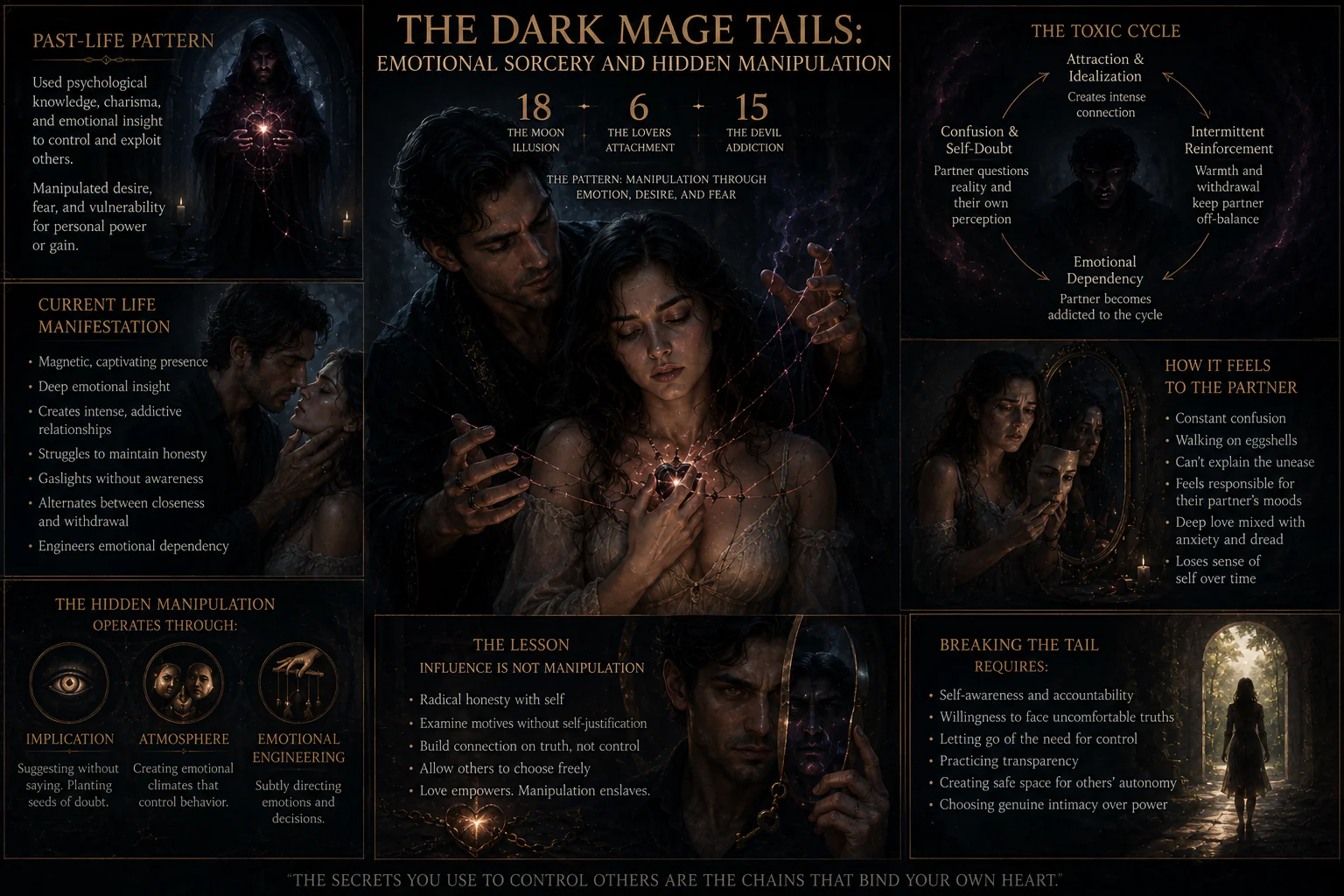
The Dark Mage tail (identified as 18-6-15 and similar combinations) represents one of the most psychologically complex toxic relationship patterns in the Destiny Matrix.
The past-life pattern involves using deep knowledge of human psychology and emotion to manipulate others. This isn’t brute force control. It’s subtle, sophisticated, and often invisible to the person being manipulated. The Dark Mage understands desire, fear, and vulnerability, and exploits all three.
In the current life, this tail produces people with a magnetic personality who attract intense connections but struggle to maintain them honestly. They may gaslight without realizing they’re doing it. They may create emotional dependency in their partner through intermittent reinforcement, alternating between warmth and withdrawal in a pattern that keeps the other person constantly off-balance.
The toxic cycle is one of the hardest to identify from inside the relationship. The partner of someone carrying a Dark Mage tail often feels confused, questioning their own perception, unable to explain why they feel manipulated when nothing overtly manipulative has happened. The manipulation operates below the surface, through atmosphere, implication, and emotional engineering.
Breaking this tail requires radical honesty. The person must examine their own relational tactics without self-justification. They need to ask whether they’re creating genuine connection or engineering emotional dependency. The distinction between influence and manipulation is the entire karmic lesson.
How to Identify Your Danger Zone Combination
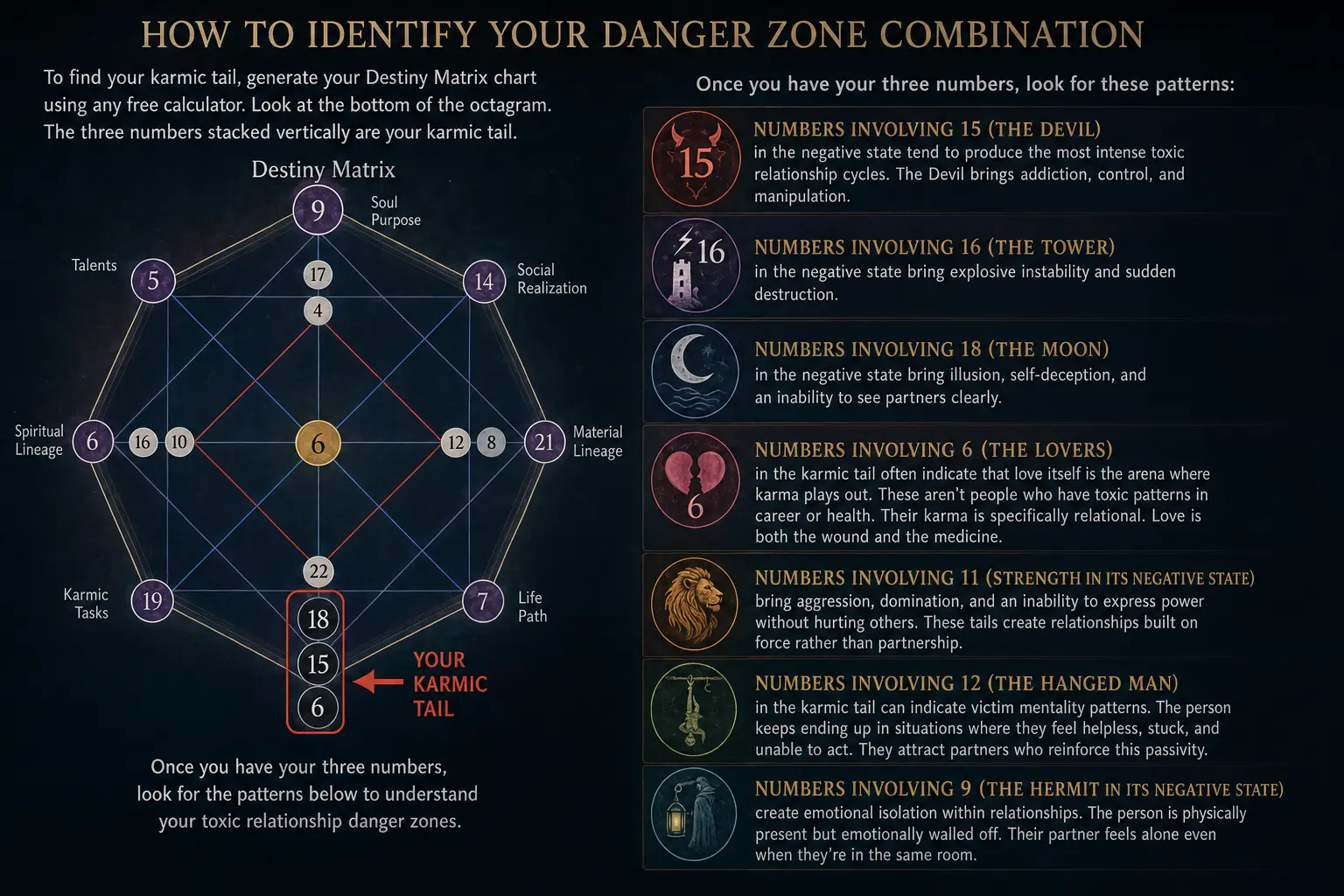
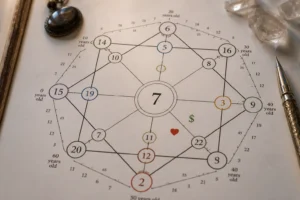
To find your karmic tail, generate your Destiny Matrix chart using any free calculator. Look at the bottom of the octagram. The three numbers stacked vertically are your karmic tail.
Once you have your three numbers, look for these patterns:
Numbers involving 15 (The Devil), 16 (The Tower), or 18 (The Moon) in the negative state tend to produce the most intense toxic relationship cycles. The Devil brings addiction, control, and manipulation. The Tower brings explosive instability and sudden destruction. The Moon brings illusion, self-deception, and an inability to see partners clearly.
Numbers involving 6 (The Lovers) in the karmic tail often indicate that love itself is the arena where karma plays out. These aren’t people who have toxic patterns in career or health. Their karma is specifically relational. Love is both the wound and the medicine.
Numbers involving 11 (Strength) in the negative state bring aggression, domination, and an inability to express power without hurting others. These tails create relationships built on force rather than partnership.
Numbers involving 12 (The Hanged Man) in the karmic tail can indicate victim mentality patterns. The person keeps ending up in situations where they feel helpless, stuck, and unable to act. They attract partners who reinforce this passivity.
Numbers involving 9 (The Hermit) in the negative state create emotional isolation within relationships. The person is physically present but emotionally walled off. Their partner feels alone even when they’re in the same room.
How to Break a Toxic Karmic Cycle
Understanding which tail combination you carry is the diagnostic step. But diagnosis alone doesn’t heal anything. Here’s what actually breaks the loop.
Name the pattern out loud. Karmic cycles survive in the dark. They lose power when you articulate them clearly. “I keep choosing partners who control me because I carry unresolved captivity karma” is infinitely more useful than “I just have bad luck in love.” Naming it is the first crack in the cycle.
Stop blaming the other person. This is the hardest step and the most important one. The karmic tail framework says something uncomfortable: you are attracting these dynamics because of your own unresolved energy. The other person is playing a role that your karma invited. That’s not victim-blaming. It’s self-empowerment. If you caused the invitation, you can revoke it.
Work on the specific shadow your tail describes. If your tail involves control, practice letting go. If it involves manipulation, practice radical honesty. If it involves aggression, find physical outlets for your energy and learn conflict resolution. If it involves pride, practice vulnerability. The work is specific to the pattern. Generic self-improvement doesn’t touch karmic energy. Targeted behavioral change does.
Watch for the karmic loop signal. The loop signal is the moment in a new relationship where the old pattern tries to activate. You’ll feel it as a familiar pull, a sensation of “here we go again.” That moment is the fork in the road. The old response leads back into the cycle. A new response breaks it. Recognizing the signal in real time is the skill that ends the loop.
Accept that the lesson might take more than one relationship to learn. Karmic tails didn’t form in a single lifetime. They won’t necessarily resolve in a single relationship. The goal isn’t perfection. It’s progress. Each relationship that ends with more self-awareness than the last is the karmic tail losing power, even if the relationship itself didn’t last.
The Bottom Line
Not every karmic tail produces toxic relationships. Some tails focus on career, health, creativity, or spiritual development. But the tails that do target relationships create some of the most painful, repetitive, and confusing cycles a person can experience.
The Destiny Matrix doesn’t frame these cycles as punishment. It frames them as information. Your karmic tail tells you exactly which pattern is running, why it keeps repeating, and what specific change would break it. The numbers don’t judge. They just describe.
The cycle ends when you stop waiting for a different partner and start becoming a different participant. That’s the only exit from a karmic loop. Not a better partner. A more conscious you.