
If you have spent any time in the self discovery space, you have probably come across both the destiny matrix and Human Design. They look similar on the surface. Both use your birth data. Both produce detailed charts. Both claim to reveal your unique energetic blueprint. And both draw from ancient traditions to do it.
But the moment you sit down with both systems side by side, the differences become obvious. They use different inputs, different structures, different classification systems, and ultimately answer different questions about who you are.
This guide breaks down the key differences between the destiny matrix and Human Design clearly and honestly, so you can understand which system does what, where they overlap, and which one might serve you better depending on what you are looking for.
The Founders: Two Different Origin Stories
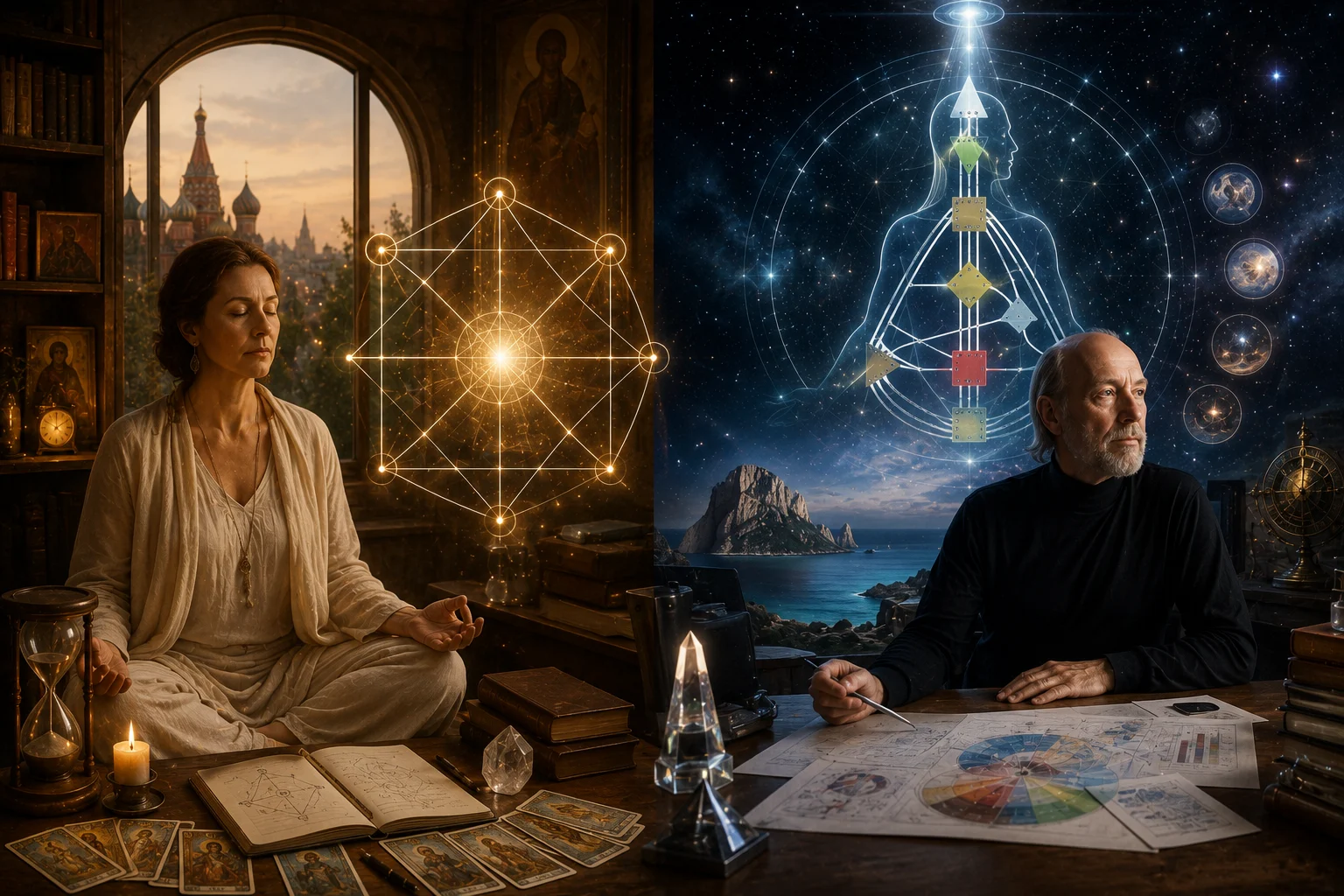
The destiny matrix was created by Natalia Ladini in 2006. Ladini is a Moscow born philosopher, author, and spiritual practitioner who developed the system during a meditation in which she envisioned two overlapping squares forming an octagram. She spent years refining how the 22 Major Arcana from the tarot could be mapped onto this geometric structure, using only a person’s date of birth. Her method spread rapidly through Russian speaking esoteric communities before reaching the English speaking world. Today, more than 100,000 practitioners use her system globally.
If you want the full story of how the method was developed, our Natalia Ladini method guide covers her background and process in depth.
Human Design was created by Ra Uru Hu (born Robert Alan Krakower) in 1987. Krakower was a Canadian born artist and musician living in Ibiza, Spain, when he described having a mystical encounter with a “Voice” that communicated information about the nature of humanity over eight consecutive days. He spent the following years developing that information into a formal system. Ra Uru Hu dedicated the rest of his life to teaching Human Design before passing away in 2011.
Both systems were born from deeply personal experiences. Ladini’s from meditation. Ra Uru Hu’s from what he described as a direct transmission. Neither system emerged from an academic institution, and both initially spread through small communities before gaining wider recognition.
What Data Each System Requires
This is one of the most practical differences between the two systems and the one that matters most if you are trying to decide which chart to calculate first.
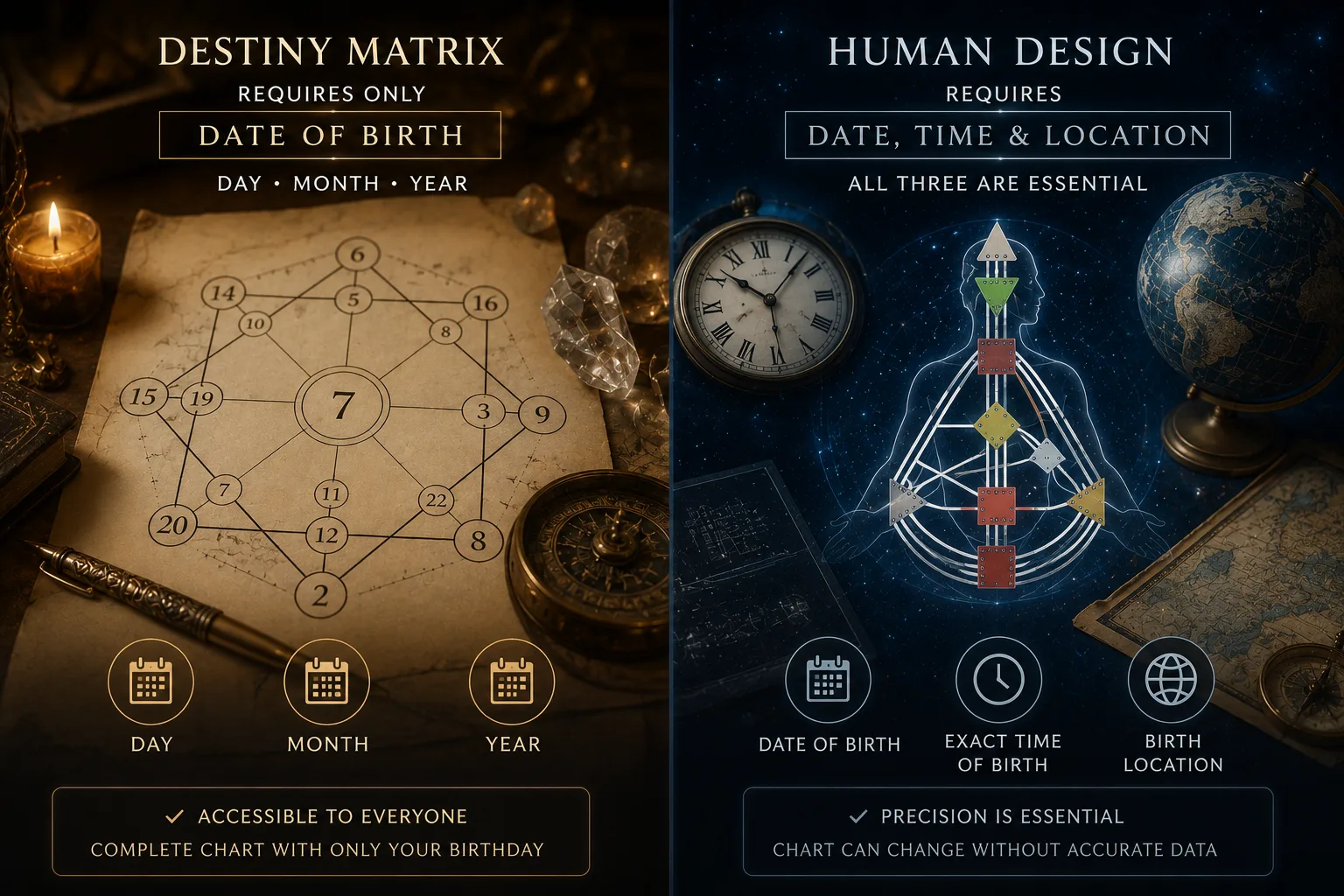
Destiny Matrix requires only your date of birth. Day, month, and year. That is it. No birth time. No birth location. The entire chart is derived from three numbers reduced to fit within the 1 to 22 range. This makes it accessible to virtually everyone, since most people know their birthday even if they have no idea what time they were born.
Human Design requires your date of birth, exact birth time, and birth location. All three are essential because the system relies on precise planetary positions at the moment you were born, as well as positions from approximately 88 days before birth. Without an accurate birth time, the chart can shift significantly, potentially changing your Type, Authority, and defined Centers.
This difference alone determines which system is more accessible. If you do not know your birth time, you can still get a complete and accurate destiny matrix chart. You cannot get a reliable Human Design chart without it.
If you want to calculate your destiny matrix right now, our free calculator only needs your birthday. For finding your most important number, our how to find your central arcana guide walks you through it by hand.
The Ancient Systems They Draw From
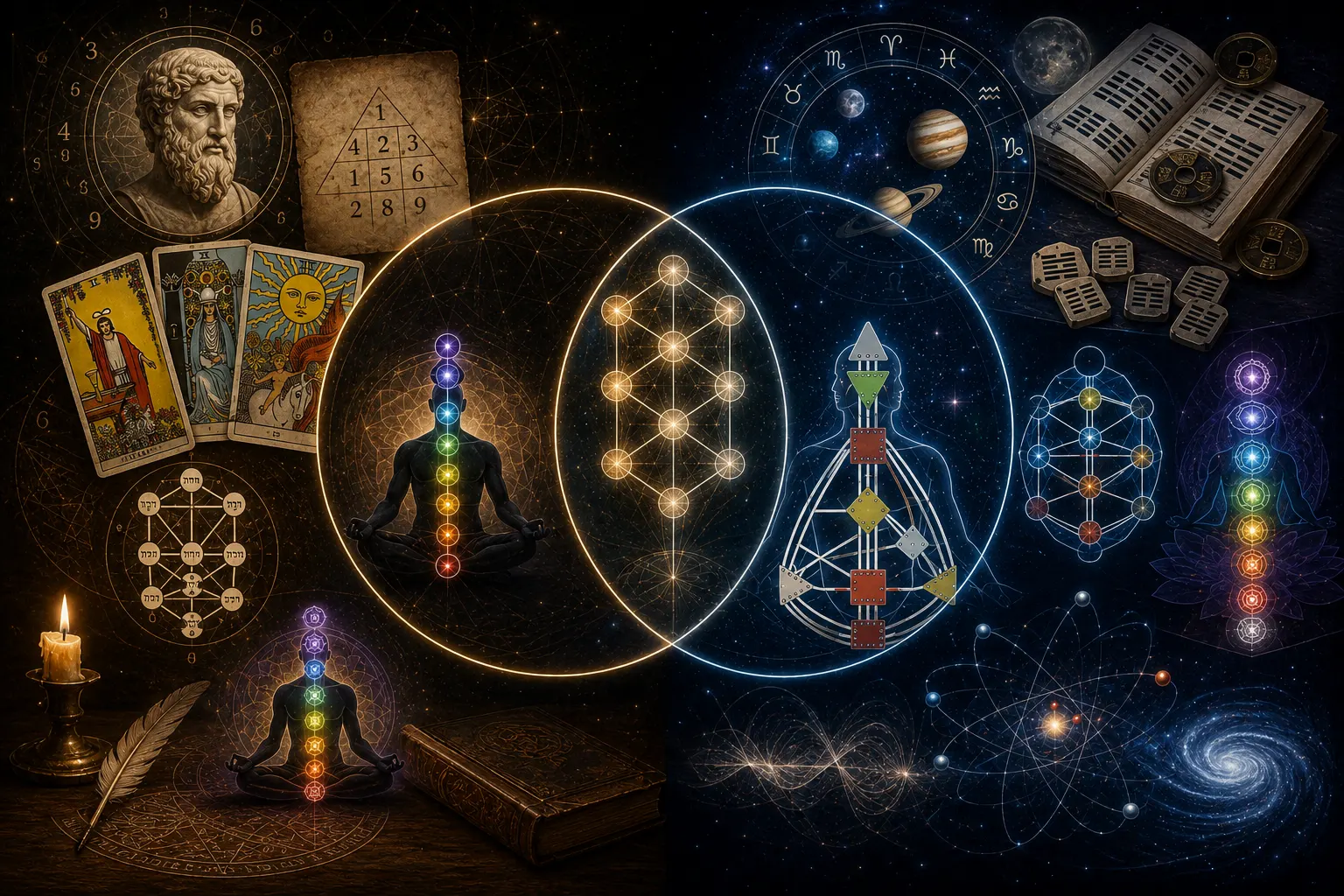
Both the destiny matrix and Human Design are synthesis systems, meaning they combine multiple older traditions into one unified framework. But the traditions they draw from are only partially overlapping.
Destiny Matrix combines: Pythagorean numerology (the mathematical foundation for reducing birth date numbers), the 22 Major Arcana of Tarot from the Rider Waite tradition (used as archetypal energy patterns, not for divination), Kabbalistic principles (informing how energies connect and flow through the chart), and the seven center Chakra system (linking chart positions to energy centers in the body).
Human Design combines: Western Astrology (planetary positions determine chart activations), the I Ching and its 64 Hexagrams (each mapped to a Gate in the chart), Kabbalistic Tree of Life (influencing the Channel structure between Centers), the Hindu Brahmin Chakra system expanded to nine Centers (adding the Spleen, Ego, and Identity Centers beyond the traditional seven), and concepts from Quantum Physics (particularly around the mechanics of consciousness and differentiation).
The overlap is notable. Both systems use elements of Kabbalah and the Chakra system. But the destiny matrix leans more heavily on tarot archetypes and numerology, while Human Design leans more heavily on astrology, the I Ching, and planetary mechanics.
Chart Structure: Octagram vs BodyGraph
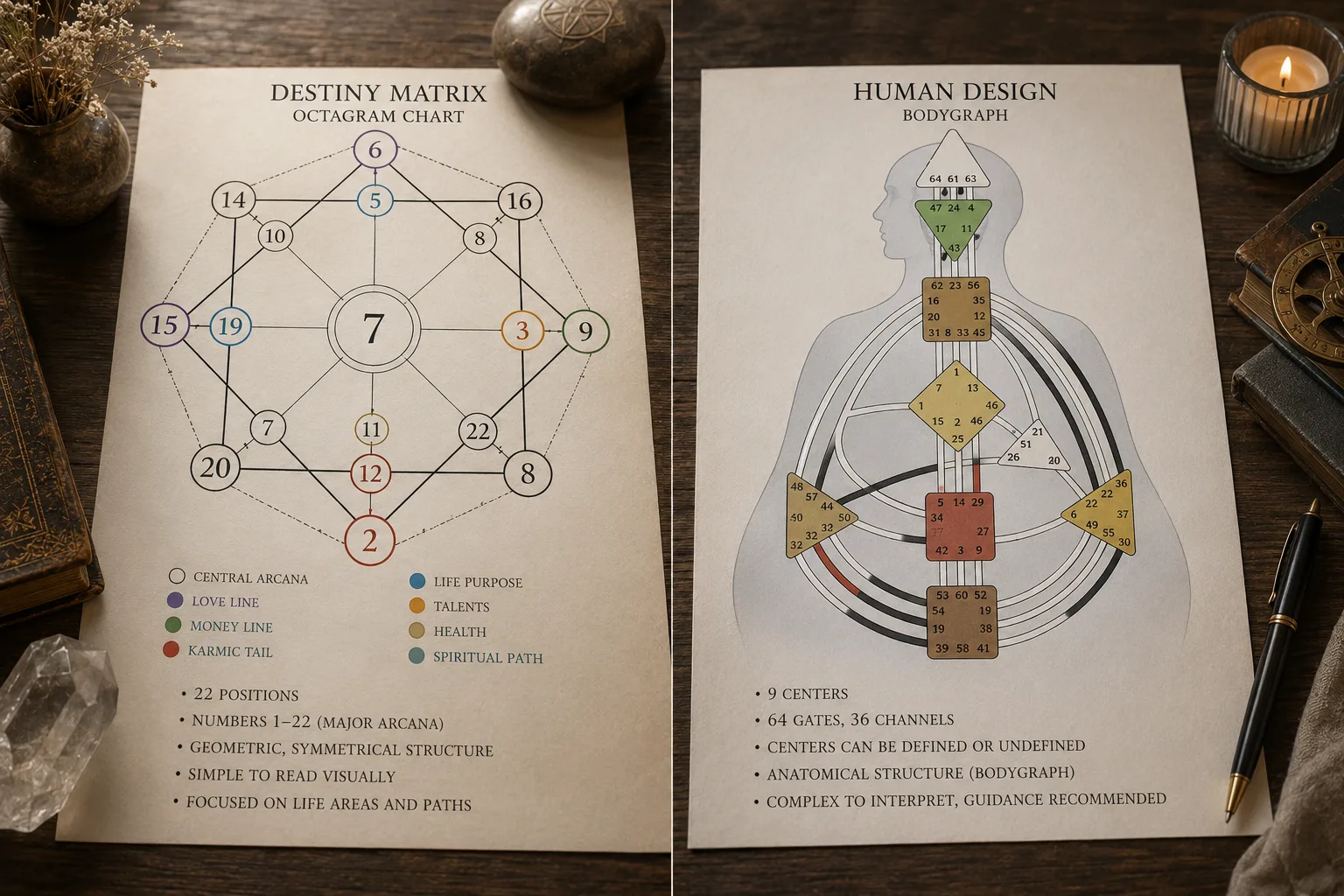
When you look at a destiny matrix chart and a Human Design chart side by side, they look nothing alike. And that visual difference reflects a fundamentally different approach to mapping human energy.
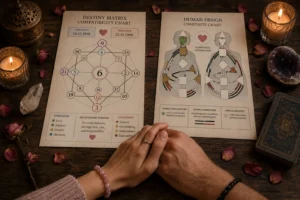
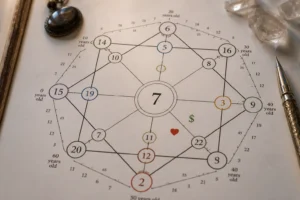
The Destiny Matrix chart is an octagram, an eight pointed star formed by two overlapping squares. It contains 22 active positions, each holding a number between 1 and 22 that corresponds to a Major Arcana archetype. The centre number sits at the heart of the chart. Surrounding positions map to specific life areas: love line, money line, karmic tail, life purpose, talents, and health. The structure is geometric, symmetrical, and compact.
The Human Design BodyGraph resembles a stylized human body containing nine geometric shapes (Centers) connected by lines (Channels) with numbers at each end (Gates). The chart uses 9 Centers, 64 Gates, and 36 Channels. Centers can be either defined (colored in, representing consistent energy) or undefined (white, representing areas of openness and sensitivity). The structure is anatomical rather than geometric.
The destiny matrix chart is simpler to read visually. The Human Design BodyGraph is more complex and typically requires guidance from a trained analyst to interpret fully, at least for beginners.
How Each System Classifies You
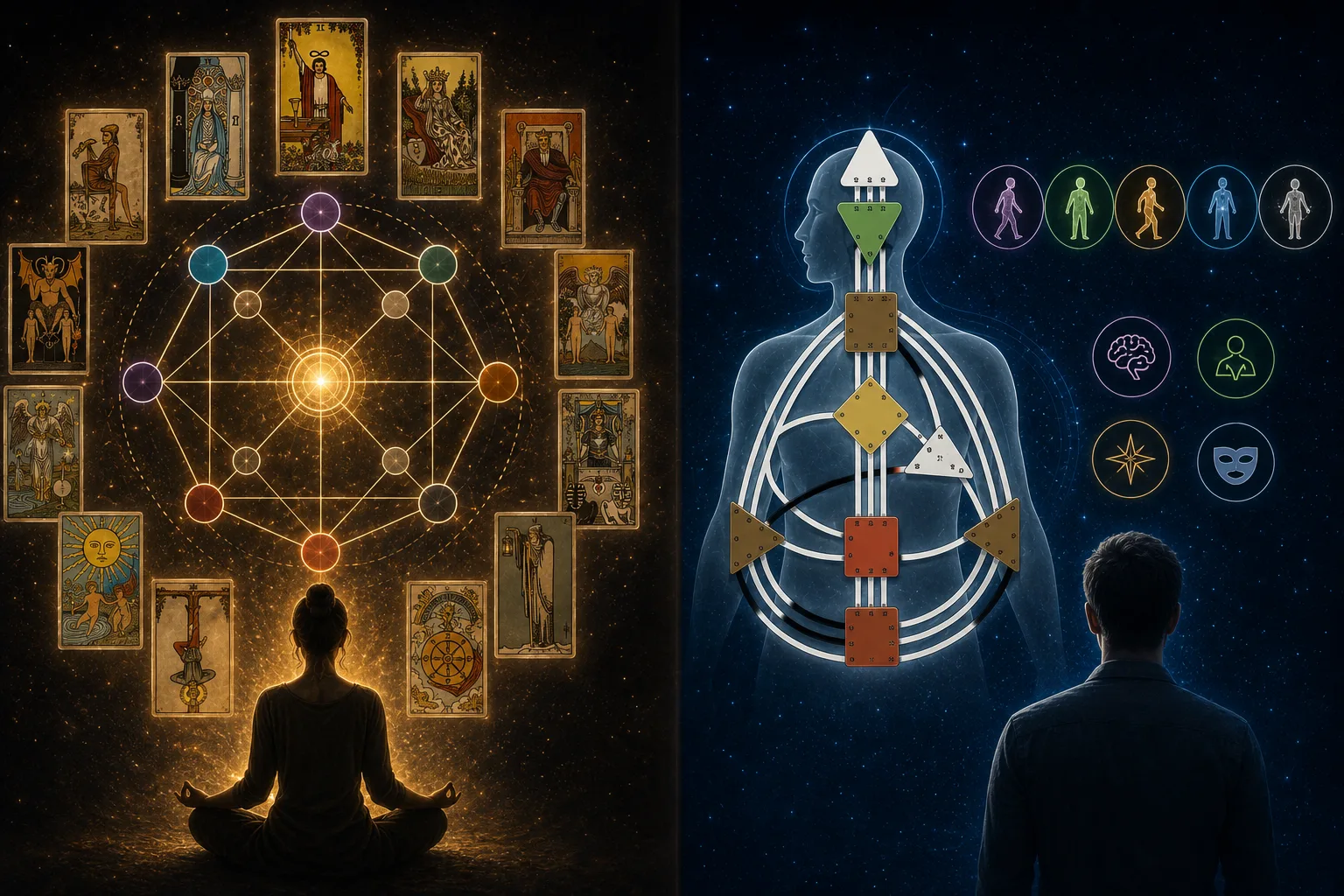
This is where the two systems diverge most sharply.
The Destiny Matrix uses 22 archetypal energies. Your chart places different numbers (1 through 22) in different positions, and each number carries the energy of a corresponding Major Arcana. There are no “types” in the destiny matrix. Instead, every person is understood through the unique combination of arcana in their chart. Each arcana has a positive expression (gifts, strengths, flow) and a negative expression (shadows, blocks, recurring problems). The goal is to shift each energy from its negative state toward its positive state through awareness and conscious action.
Human Design classifies people into five Types: Manifestor (approximately 9% of the population), Generator (approximately 37%), Manifesting Generator (approximately 33%), Projector (approximately 20%), and Reflector (approximately 1%). Your Type determines your core strategy for making decisions and interacting with the world. Beyond Type, Human Design assigns you an Authority (your inner decision making compass), a Profile (a two number combination describing your life theme), and an Incarnation Cross (your broader life purpose). Each Type also has a “Not Self Theme,” which is the feeling you experience when living out of alignment.
In simple terms: the destiny matrix tells you which energies are active in which areas of your life. Human Design tells you what type of energetic being you are and how you are designed to make decisions.
What Each System Focuses On
The destiny matrix and Human Design answer fundamentally different primary questions.
The Destiny Matrix primarily answers: What energies govern my personality, relationships, finances, purpose, and karmic patterns? Where am I operating in the positive? Where am I stuck in the negative? What lessons keep repeating and why?
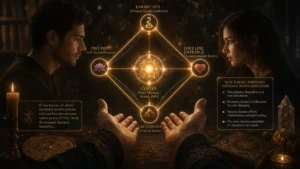
The system is particularly strong in relationship analysis. The compatibility matrix generates a combined chart for two people, revealing the energy at the center of the relationship, shared karmic patterns, and specific areas of harmony or tension. The love line and money line provide focused readings for relationships and finances respectively.
Human Design primarily answers: How am I designed to make decisions? How does my energy work? Where am I being conditioned by others? What is my correct strategy for navigating life?
Human Design excels at explaining energy dynamics. Why some people feel drained at the end of the workday (undefined Sacral Center) while others feel energized. Why some people need to wait for invitations (Projectors) while others need to initiate (Manifestors). It is fundamentally a decision making system.
Neither system is “better.” They answer different questions. Many practitioners use both.
Complexity and Learning Curve
This matters practically because it determines how quickly you can start using the system in your life.
The Destiny Matrix was designed by Natalia Ladini to be accessible without prior knowledge of tarot, numerology, or esoteric traditions. The calculation requires basic arithmetic. The chart uses 22 energies, each with a clear positive and negative description. Most people can read their own chart at a basic level within an hour of first encountering the system. The simplicity is intentional and is a major reason for its rapid global spread.
Human Design has a significantly steeper learning curve. The system uses specialized vocabulary (Strategy, Authority, Definition, Gates, Channels, Incarnation Cross, Variable) and the interactions between components are layered and conditional. Understanding your Type and Strategy might take an afternoon. Understanding your full chart, including Gates, Channels, and Profile, can take months of study. Ra Uru Hu himself said the deconditioning process takes approximately seven years.
If you want something you can apply to your life today, the destiny matrix gives you faster access to actionable insights. If you are willing to invest significant time in deeper study, Human Design offers an extraordinarily detailed system.
How Each System Handles Shadow Work
Both systems acknowledge that people have patterns that hold them back. But they frame those patterns very differently.
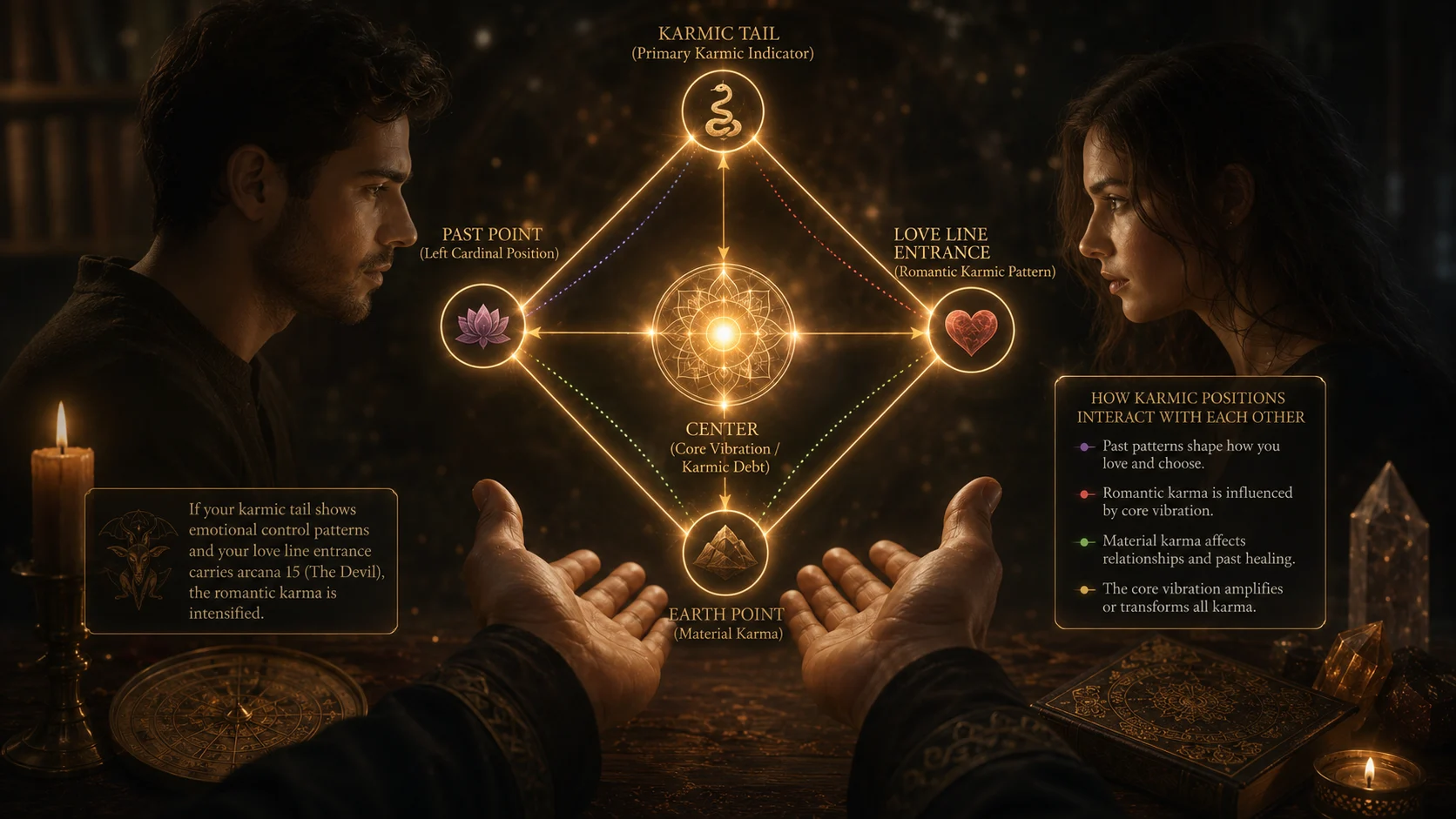
In the Destiny Matrix, every number has a positive and negative expression. The negative state is described in concrete behavioral terms. Arcana 15 in the negative looks like manipulation, jealousy, and control. Arcana 12 in the negative looks like codependency and victim patterns. The karmic tail specifically identifies inherited or repeated shadow patterns. The system is direct about naming problems and prescribing awareness based solutions.
In Human Design, shadow manifests through conditioning and the “Not Self.” When you live according to your conditioning rather than your design, you experience your Not Self Theme: frustration (Generators), bitterness (Projectors), anger (Manifestors), or disappointment (Reflectors). The shadows are not tied to specific numbers but to the misuse of your energy, making decisions from undefined Centers, or ignoring your Authority.
The destiny matrix approach tends to be more specific and prescriptive about what the shadow looks like and how to address it. The Human Design approach tends to be broader and more process oriented, emphasizing long term deconditioning rather than targeted correction.
Compatibility and Relationships
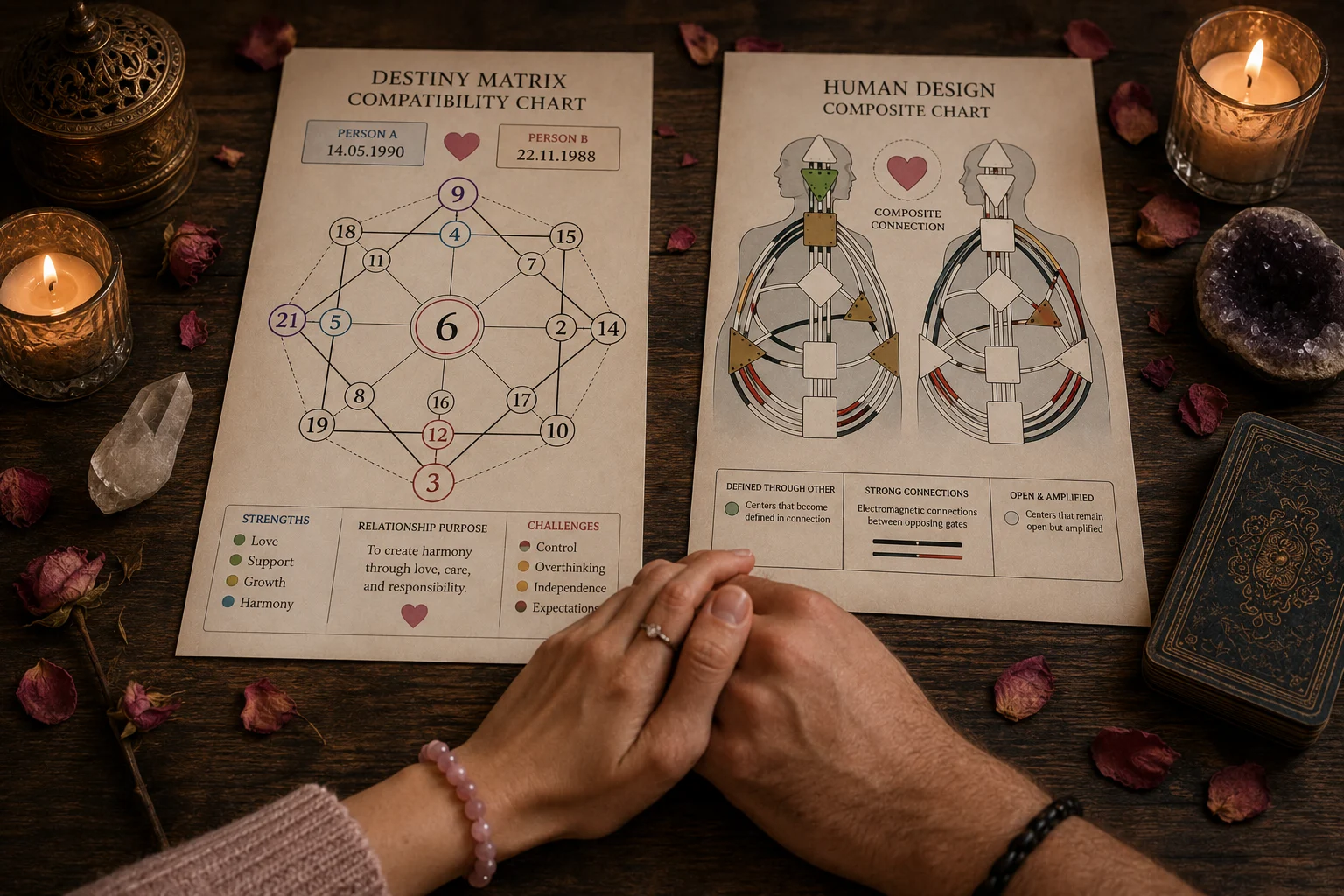
This is an area where the destiny matrix has a clear structural advantage.
The Destiny Matrix has a dedicated compatibility system built into its methodology. Two birth dates generate a combined chart with its own center number, revealing the karmic purpose of the relationship, shared energy patterns, and specific areas of strength or tension. You can explore soulmate numbers, analyze karmic relationship patterns, and even assess friendship compatibility using the same system.
Human Design does not have a native compatibility chart in the same way. Practitioners compare two individual BodyGraphs by overlaying them (called a “composite chart” or “connection chart”) to see where Centers become defined through the other person and where electromagnetic connections form through opposing Gates. This is useful but requires advanced knowledge to interpret, and there is no single “compatibility number” that summarizes the relationship.
If relationship analysis is your primary interest, the destiny matrix offers a more accessible and structured framework for it.
When to Use Which System
Rather than choosing one over the other, many people find value in using both systems for different purposes.
Use the Destiny Matrix when you want to: understand your core personality through the central arcana, identify karmic patterns that keep repeating, analyze compatibility with a partner or family member, understand your financial and relationship energy lines, get actionable insights quickly from your birth date alone, or explore a child’s chart for parenting guidance.
Use Human Design when you want to: understand your energy type and how you are designed to interact with the world, learn your optimal decision making strategy, identify where you are being conditioned by external influences, understand the mechanics of how your energy works on a daily basis, or explore advanced topics like Gene Keys, Variables, and Incarnation Crosses.
The two systems are not in competition. They examine human experience through different lenses, and insights from one can deepen your understanding of the other.
A Quick Side by Side Summary
Creator: Destiny Matrix = Natalia Ladini (2006). Human Design = Ra Uru Hu (1987).
Input required: Destiny Matrix = birth date only. Human Design = birth date, time, and location.
Chart shape: Destiny Matrix = octagram (eight pointed star). Human Design = BodyGraph (body shaped diagram).
Core components: Destiny Matrix = 22 arcana energies across 12+ positions. Human Design = 5 Types, 9 Centers, 64 Gates, 36 Channels.
Classification: Destiny Matrix = no types, 22 archetypal energies in positive/negative states. Human Design = 5 Types with Strategy, Authority, and Profile.
Primary focus: Destiny Matrix = karmic patterns, relationships, finances, life purpose. Human Design = energy mechanics, decision making, deconditioning.
Learning curve: Destiny Matrix = accessible to beginners within hours. Human Design = requires weeks to months for foundational understanding.
Compatibility: Destiny Matrix = built in compatibility chart system. Human Design = requires manual overlay of two charts.
Traditions used: Both use Kabbalah and Chakra systems. Destiny Matrix adds Tarot and Pythagorean numerology. Human Design adds Astrology, I Ching, and Quantum Physics.
Final Thought
The destiny matrix and Human Design are both legitimate self discovery systems that have helped millions of people understand themselves more deeply. They are not interchangeable, and comparing them is not about declaring a winner.
The destiny matrix gives you a karmic map. It shows you where you have been, where you are stuck, and what energy governs each area of your life. It is direct, accessible, and particularly powerful for understanding relationships.
Human Design gives you an operating manual. It shows you how your energy works, how to make aligned decisions, and where external conditioning has pulled you away from your authentic self. It is deep, mechanical, and particularly powerful for understanding your daily energy dynamics.
If you have your birth date and want to start right now, calculate your destiny matrix and see what it reveals. You might be surprised how much a few numbers and an eight pointed star can tell you about yourself.